
Fences: What You Need To Know
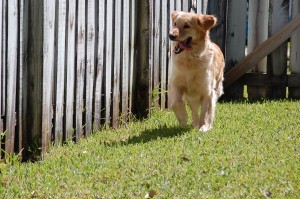
A secure fenced yard is a great way to exercise your dog. But not all fences are safe or provide the best protection for golden retrievers.
Please note that for applicants in apartments/condos, or homes without a fenced yard, a screened lanai or pool cage, a nearby fenced dog park, even in the same complex, does not meet our requirement for a fenced area.
Here are some pros and cons associated with fence types for your home:
Stockade Wood Fence
- GRRMF recommends the minimum fence height allowed is at least 4 feet, as some goldens are escape artists and can easily scale shorter fences.
- Make sure the wood is sturdy and there are no loose slats, gaps, rotten boards or holes that your dog could push through.
- Regularly inspect wood fences to keep on top of any repairs that may be needed.
- Secure gates with sturdy latches and a lock on the INSIDE of the gate. This will keep anyone from opening the gate from the outside, which is very important.
- Be sure the gap from the bottom of the gate to the ground is not large enough for the dog to shimmy under the gate to escape.
- It is always best to supervise your dog while outside, because most dogs dig and are capable of digging under any fence and in record time.
Aluminum, Vinyl or Wrought Iron Fence
- In terms of material sturdiness, any of these options would be a good choice.
- A height of at least 4 feet is required, but higher is always better.
- Measure the gaps between pickets or spindles. Is the gap wide enough for a golden retriever to get her head through? If so, she could get stuck and be injured or worse trying to get loose.
- Measure the gap between the bottom surface and the ground. Is it wide enough for a golden retriever to see underneath? This may be enough to entice your golden to try digging further to see if he can make it to the “prize” he sees on the other side.
Picket Fences – Wood or Aluminum
- A height of at least 4 feet is required.
- Measure the gaps between pickets. Is it wide enough for a golden retriever to get her head through? If so, she could get stuck and be injured or worse trying to get loose.
- Picket fences do not block your dog’s view, causing greater stimulus for barking and other nuisance behaviors.
- They also leave your dog visible to others – she could be stolen, or someone could see her and let her out while you’re not watching.
Chain Link
- A 4-foot fence is required to be considered a fence. Many older homes have this type of fencing.
- Chain link leaves your dog visible to others.
- Many dogs learn to open the U-shaped latches commonly used on chain link fence gates. Look for sturdy latches and install a lock on the INSIDE of the gate.
- Chain link fences do not block your dog’s view, causing greater stimulus for barking, running the fence, and other nuisance behaviors.
Agricultural-Type “Wire-and-Post” Fencing
- Required height is at least 4’ tall. This type may not securely contain a large dog. If it is single strands of wire that are attached to posts every 8 feet or so, this likely will not be a sufficient barrier to a dog who wishes to roam. However, if it is a woven or “tensile” type wire, which is basically woven wire in small squares like a checkerboard, with posts placed closer together so the fencing remains tight, this may be sufficient for an older dog.
- This type of fence should be looked at carefully- more pictures may be required.
Electronic or “Invisible” Fences
- With these systems, a sensor in the dog’s collar shocks him with a jolt of electricity when he goes near an underground wire boundary.
- What the manufacturers don’t tell you is the increasing number of stray animals found wearing these collars.
- Why? Many dogs brave the ZAP and run right through the boundary when the incentive is great enough, then, realizing they are going to get ZAPPED again, are too afraid to come back into their yard. In addition, owners tend to become complacent when they think their dog is “trained” to stay within its invisible boundary and forget to replace collar batteries.
- An invisible fence also offers no protection from theft or attack. In other words, it may be effective in keeping your dog from getting OUT, but it doesn’t keep other dogs or humans from coming IN.
- This type of fencing is not a safe option for your dog.
Lock it Up
Fence gates should be locked at all times to prevent workers, children or others from entering your property and potentially leaving the fence gate open. Too many times, dogs are lost or killed after escaping through an unlatched gate that the unsuspecting owner thought was secure. A padlock is best – don’t rely on the latches built into the gate. It’s possible for someone to pry the latch open or reach over and unlatch the gate. Periodically inspect your fencing and gates to make sure the perimeter is secure for your dog. Make sure your dog always wears a buckle or snap style collar with current identification tags (that includes your phone number) in case he escapes.
Leashed is Loved!
Whenever your dog is outside the fenced yard, keep him or her on a leash. Don’t fool yourself with a false sense of security when it comes to your dog. Regardless of how well trained he is, your companion, first and foremost, is a dog. And all dogs follow their instincts. It only takes ONCE … the one time he takes off after a squirrel or a passing dog, there will surely be a car in his path. Please read more about this topic in our “Leashed is Loved” section.
More info . . . Please read more about safety in our “backyard safety” section.